
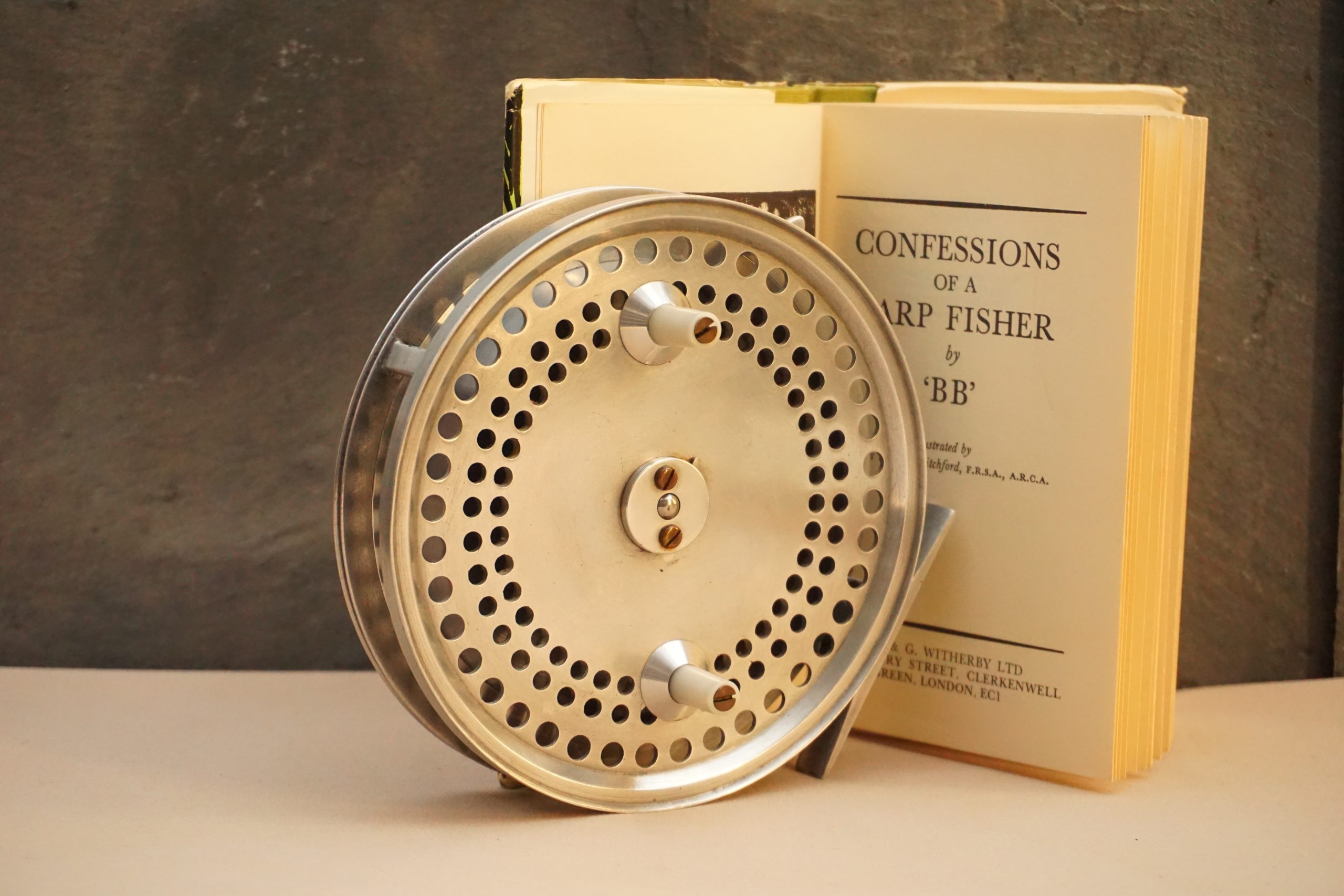
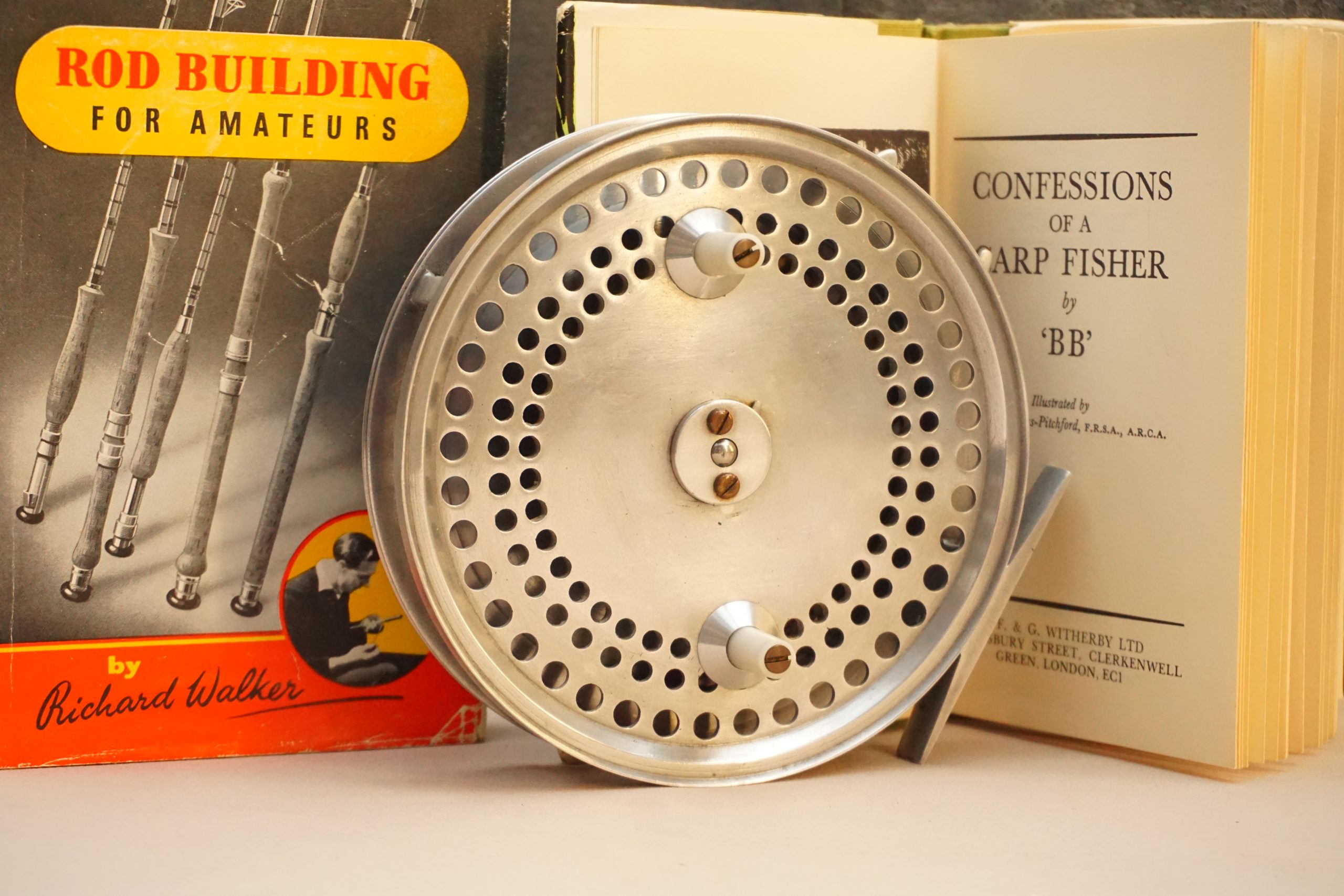
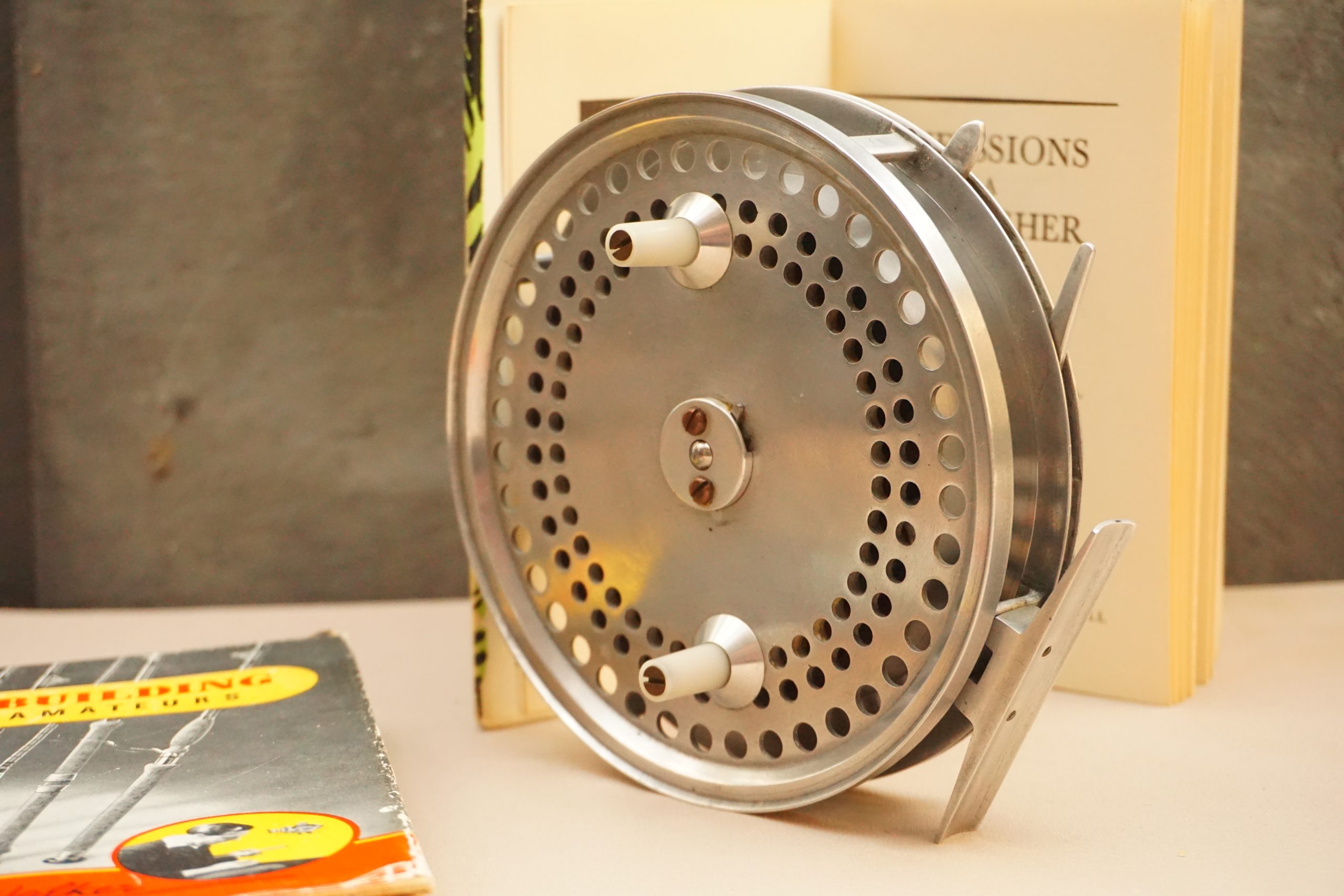
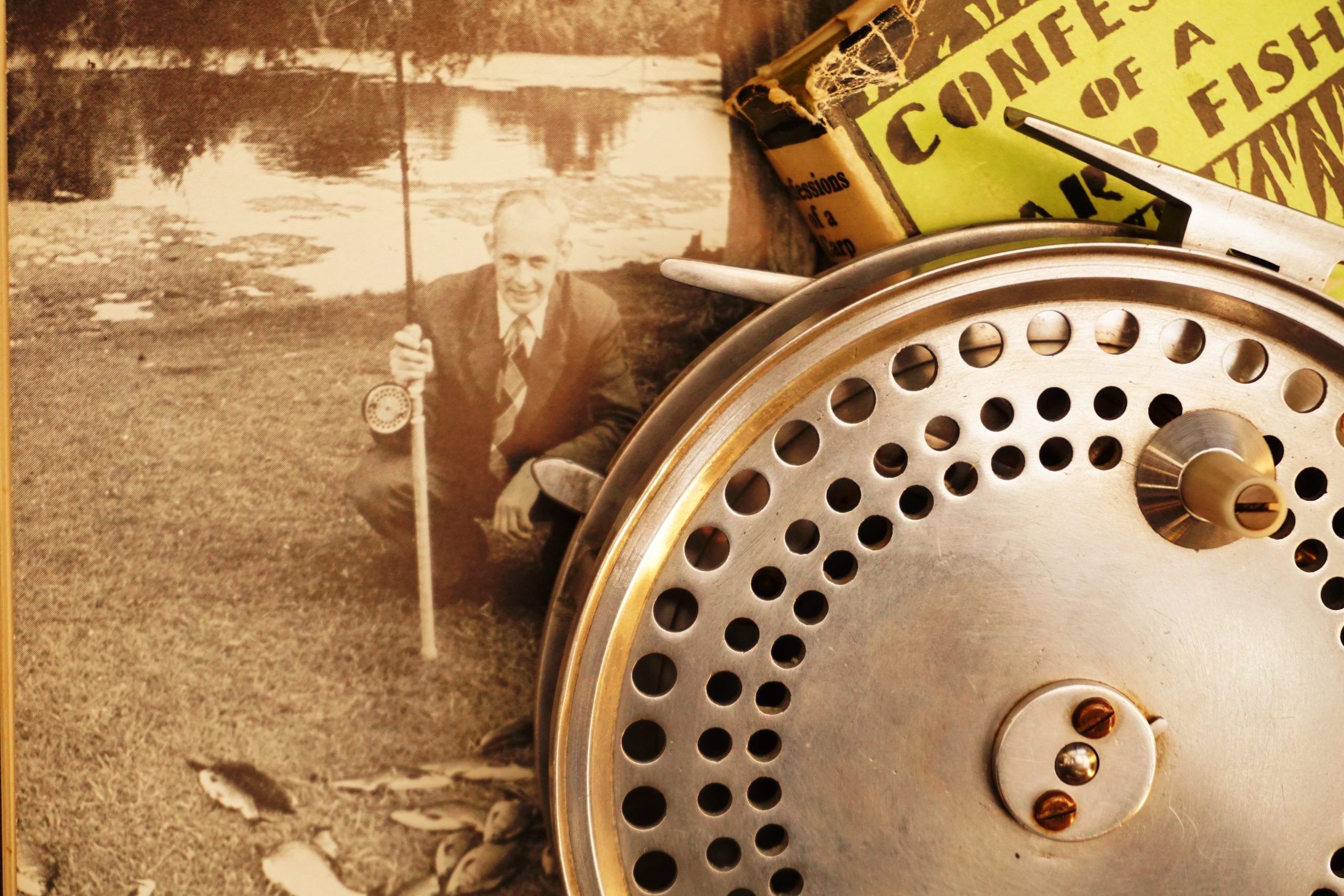
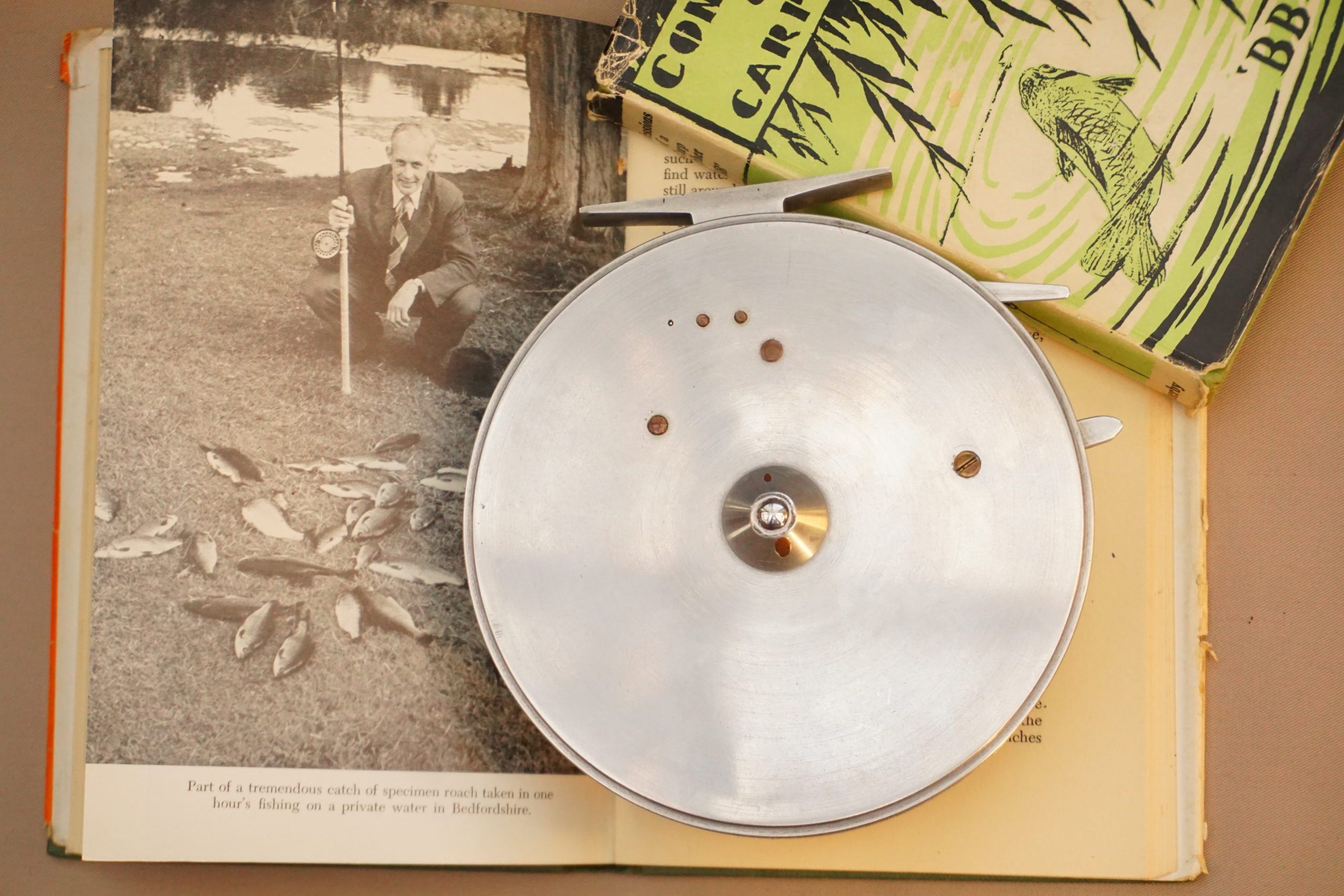
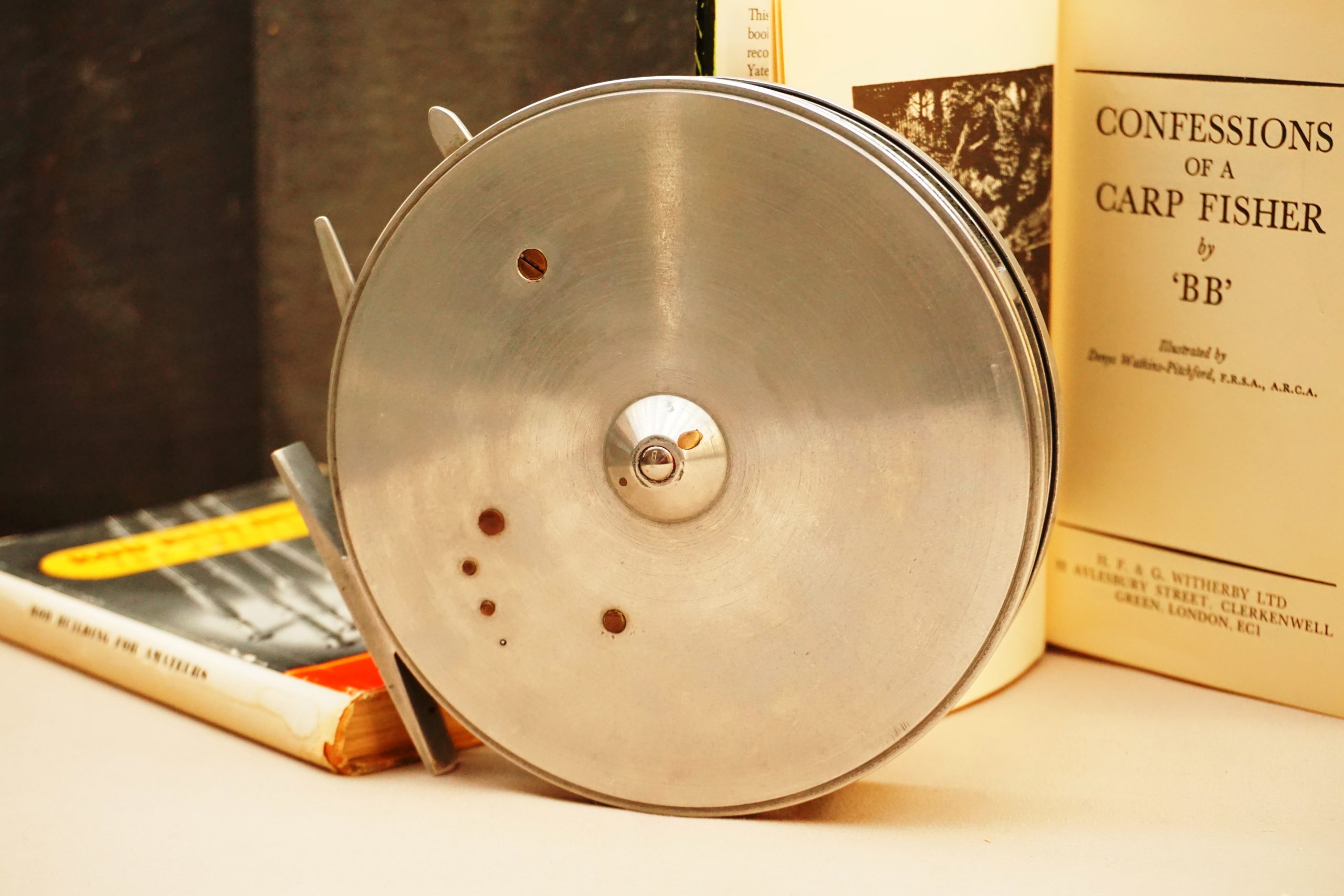
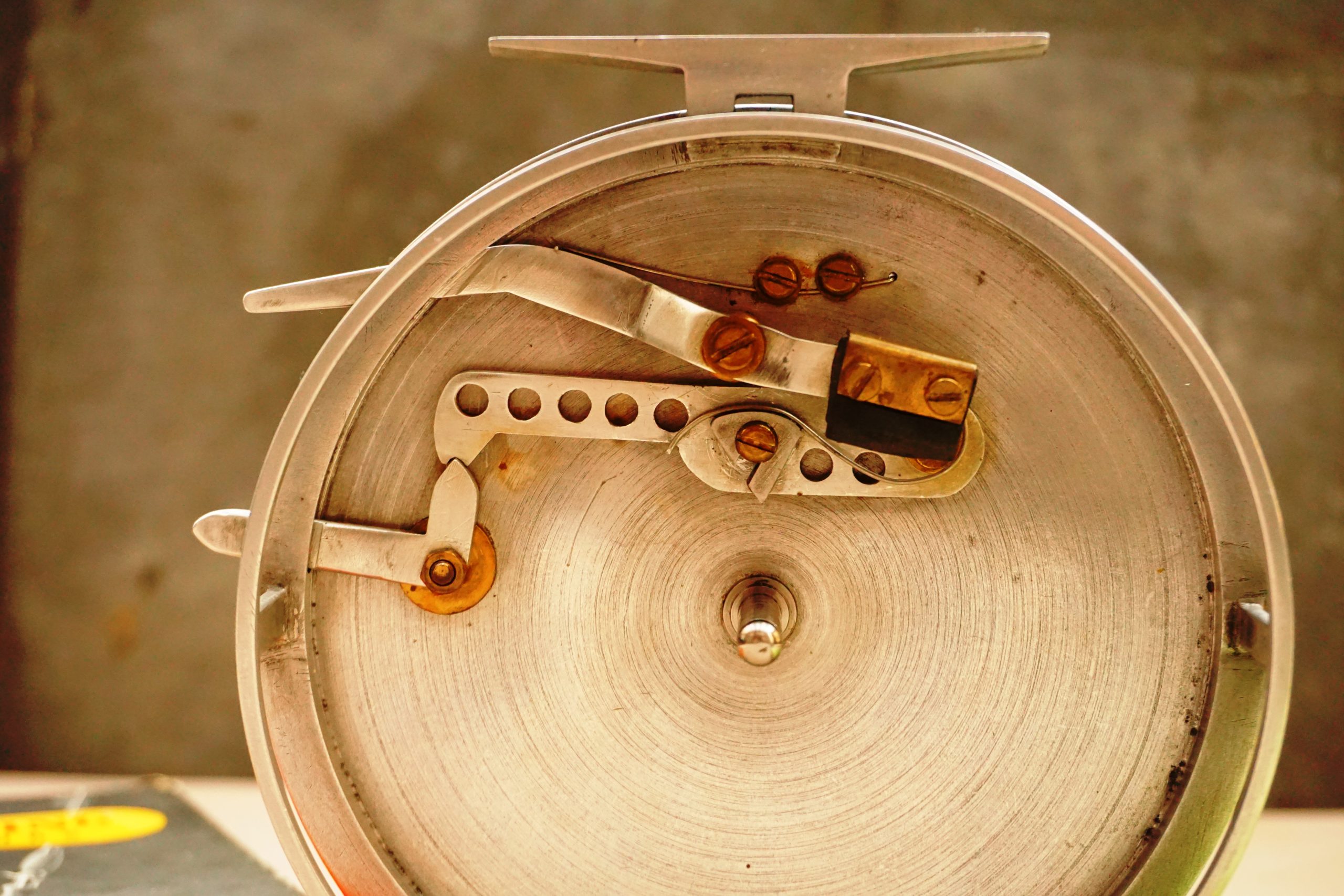
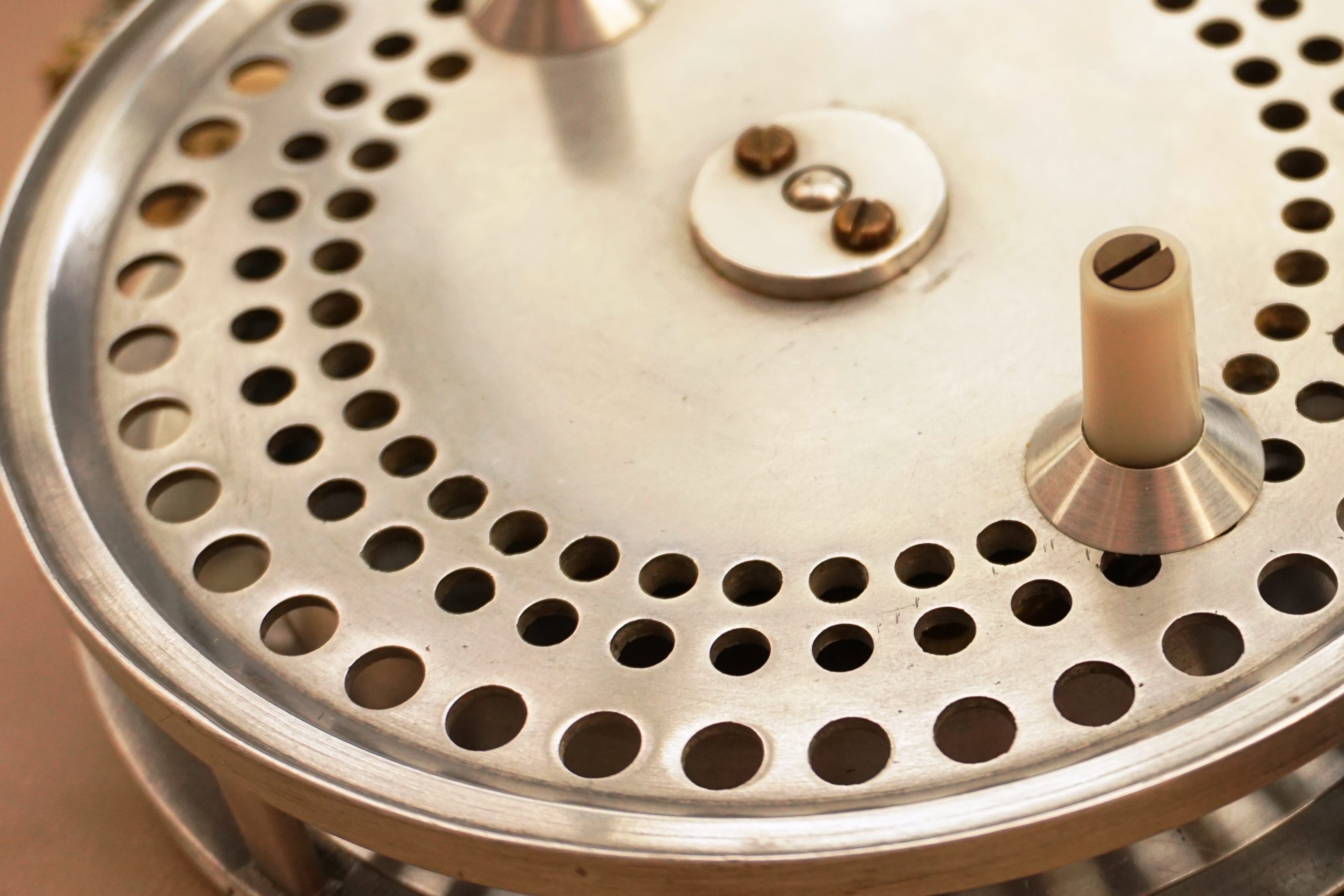
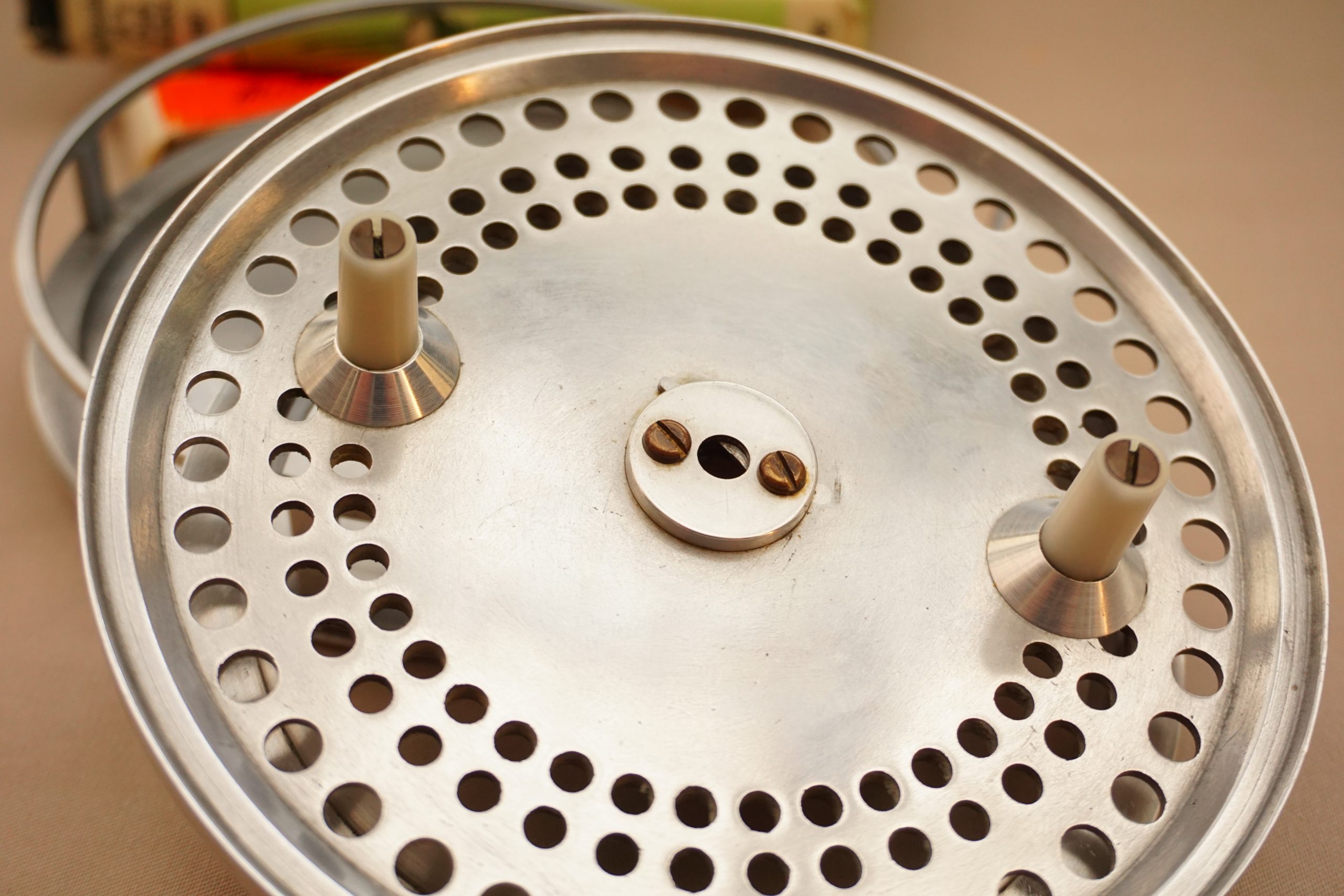
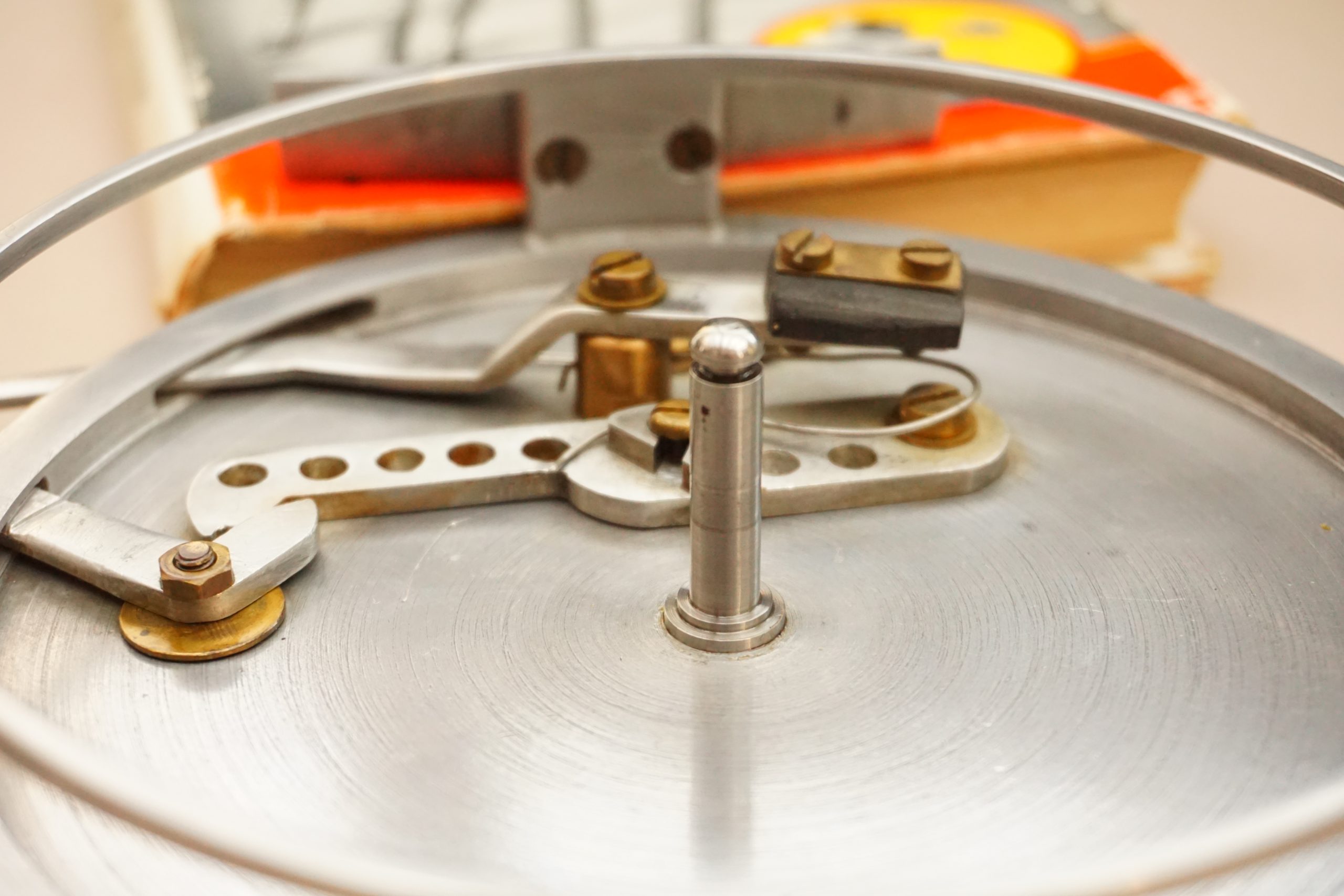
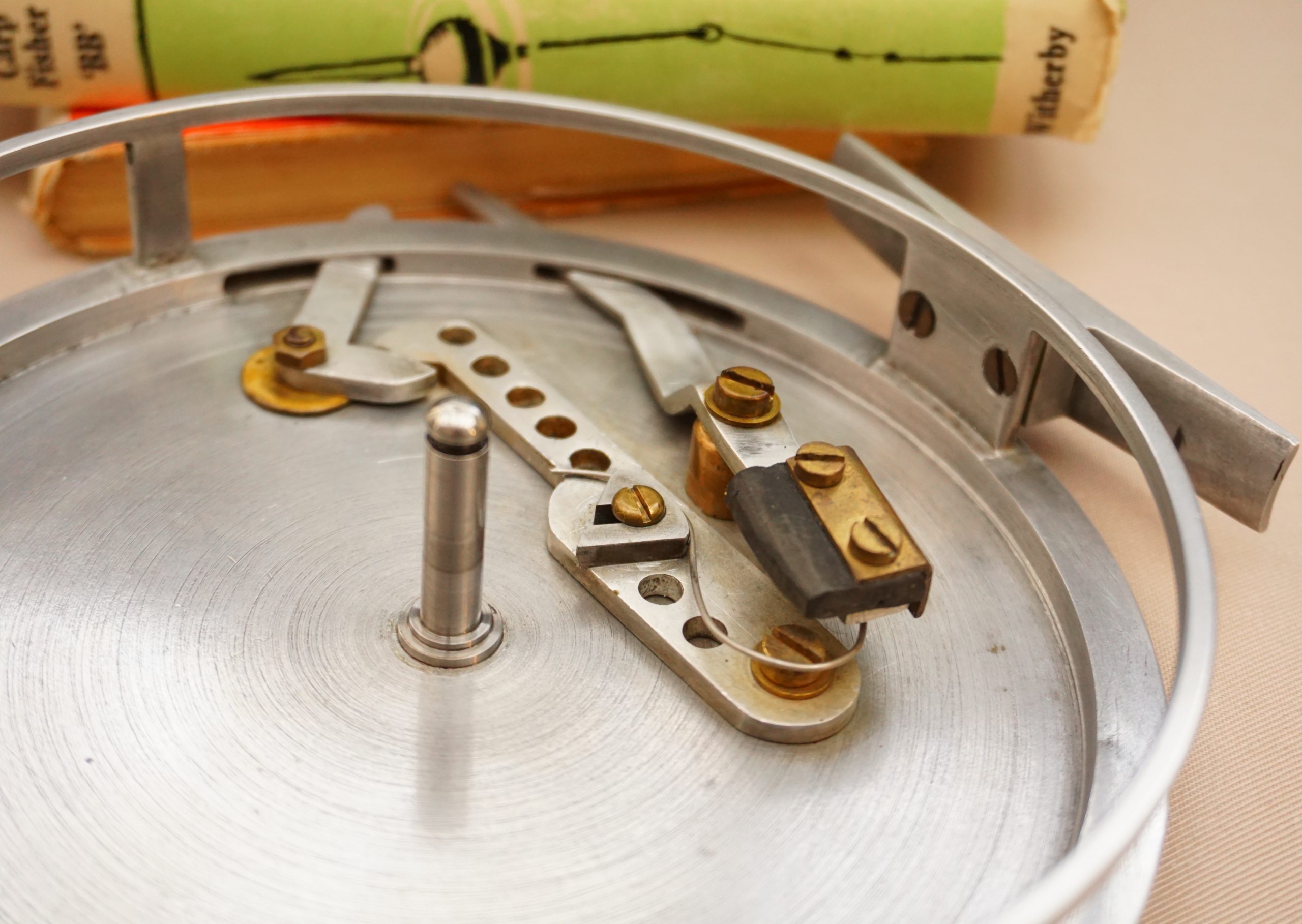
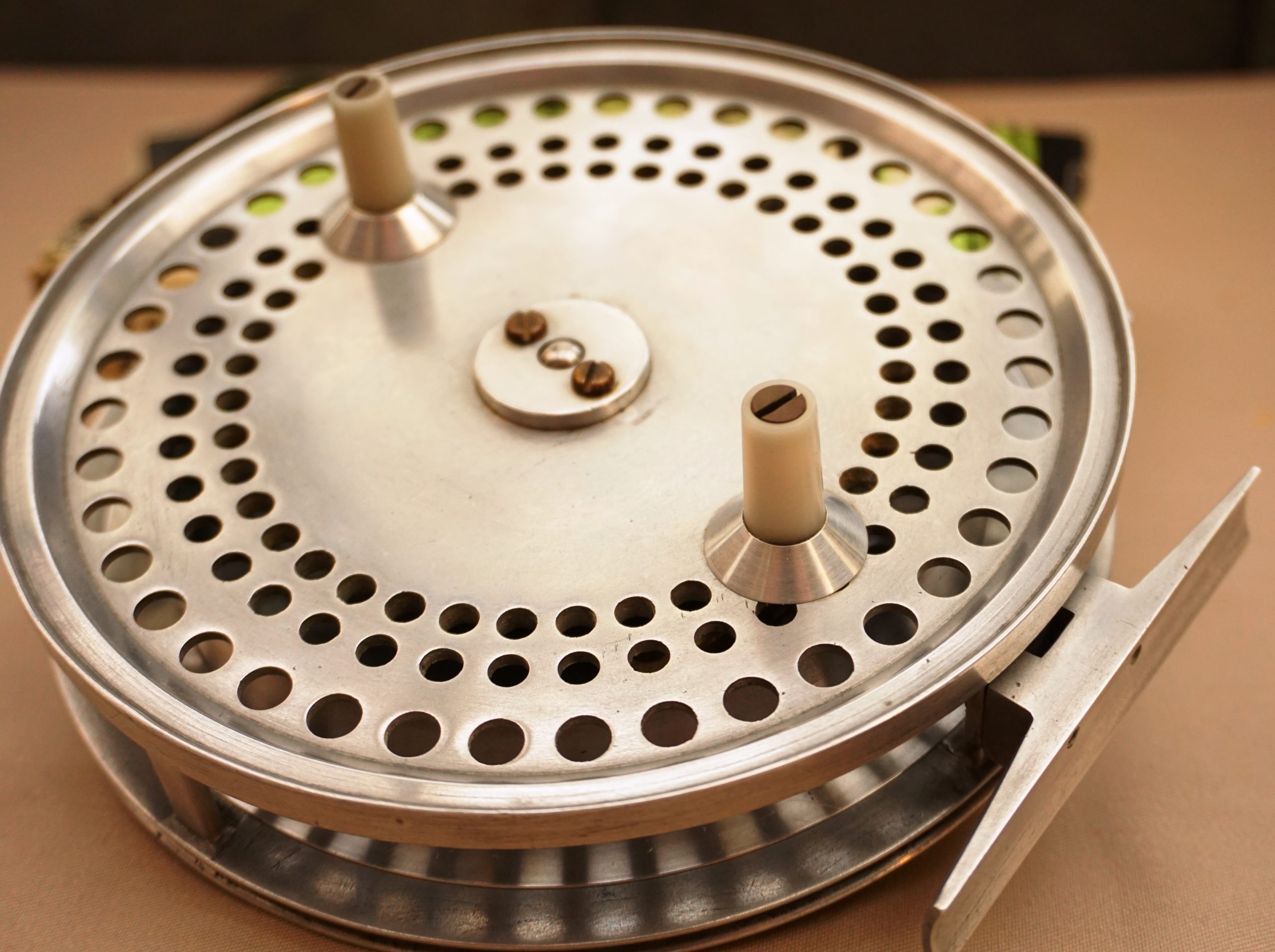
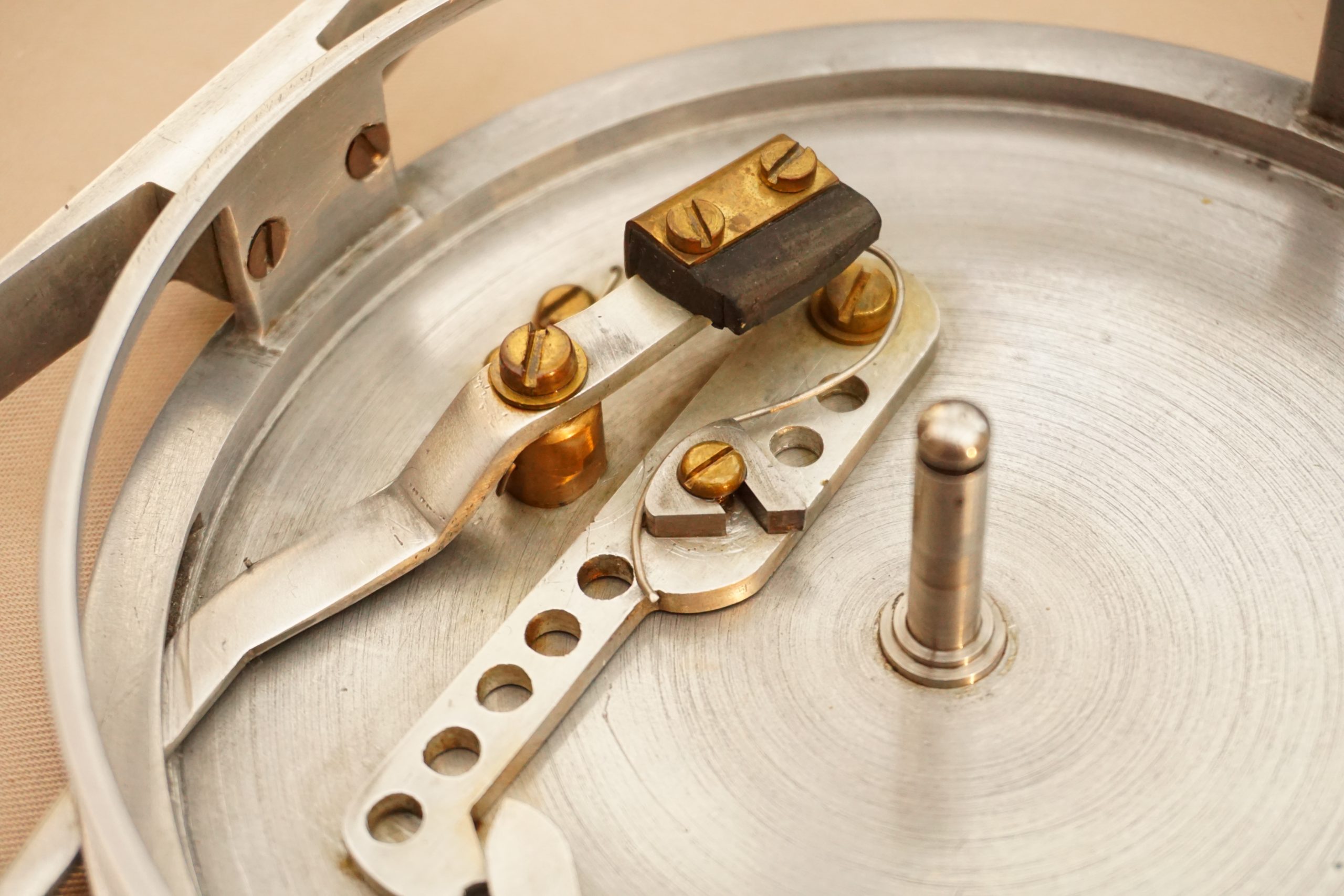
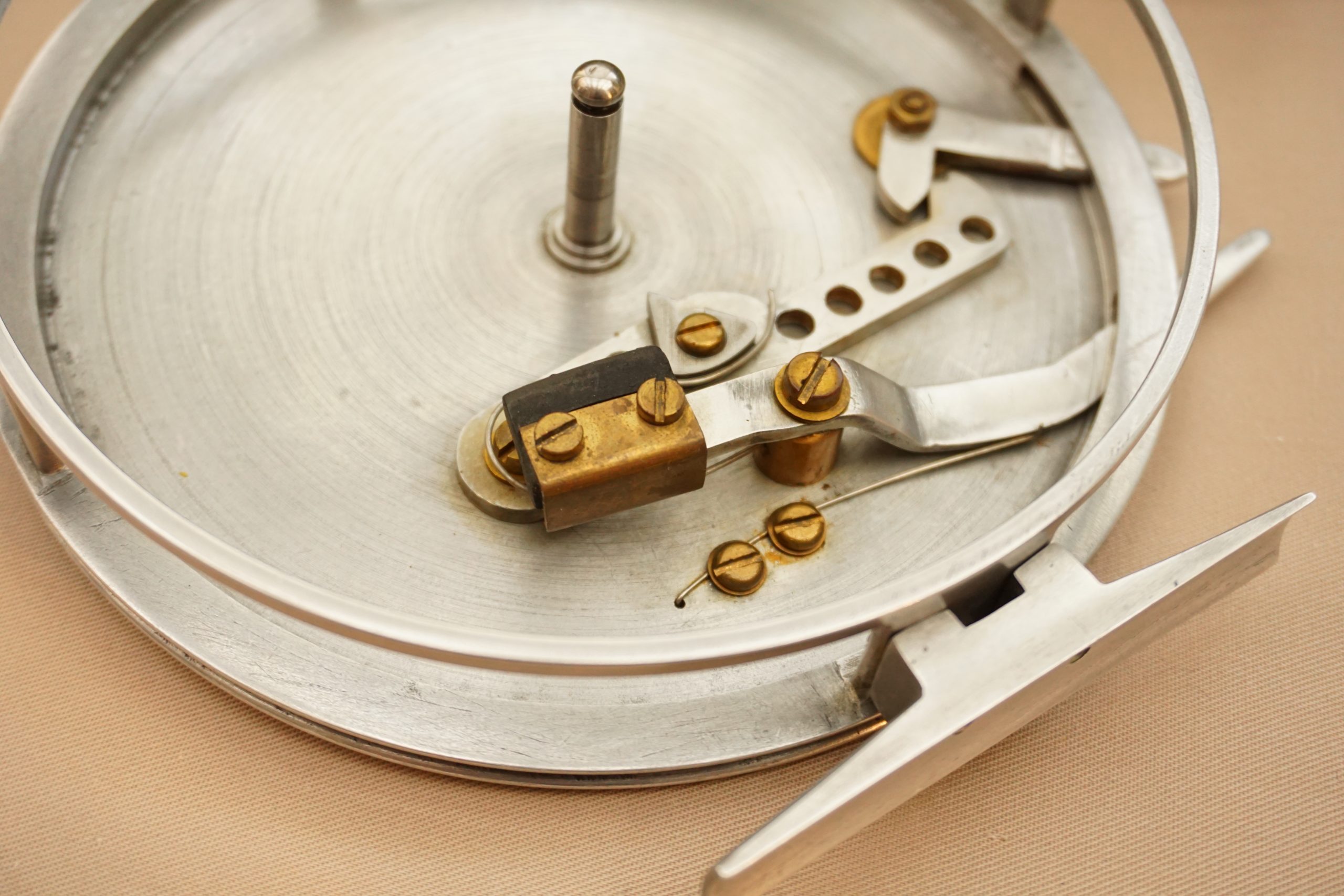
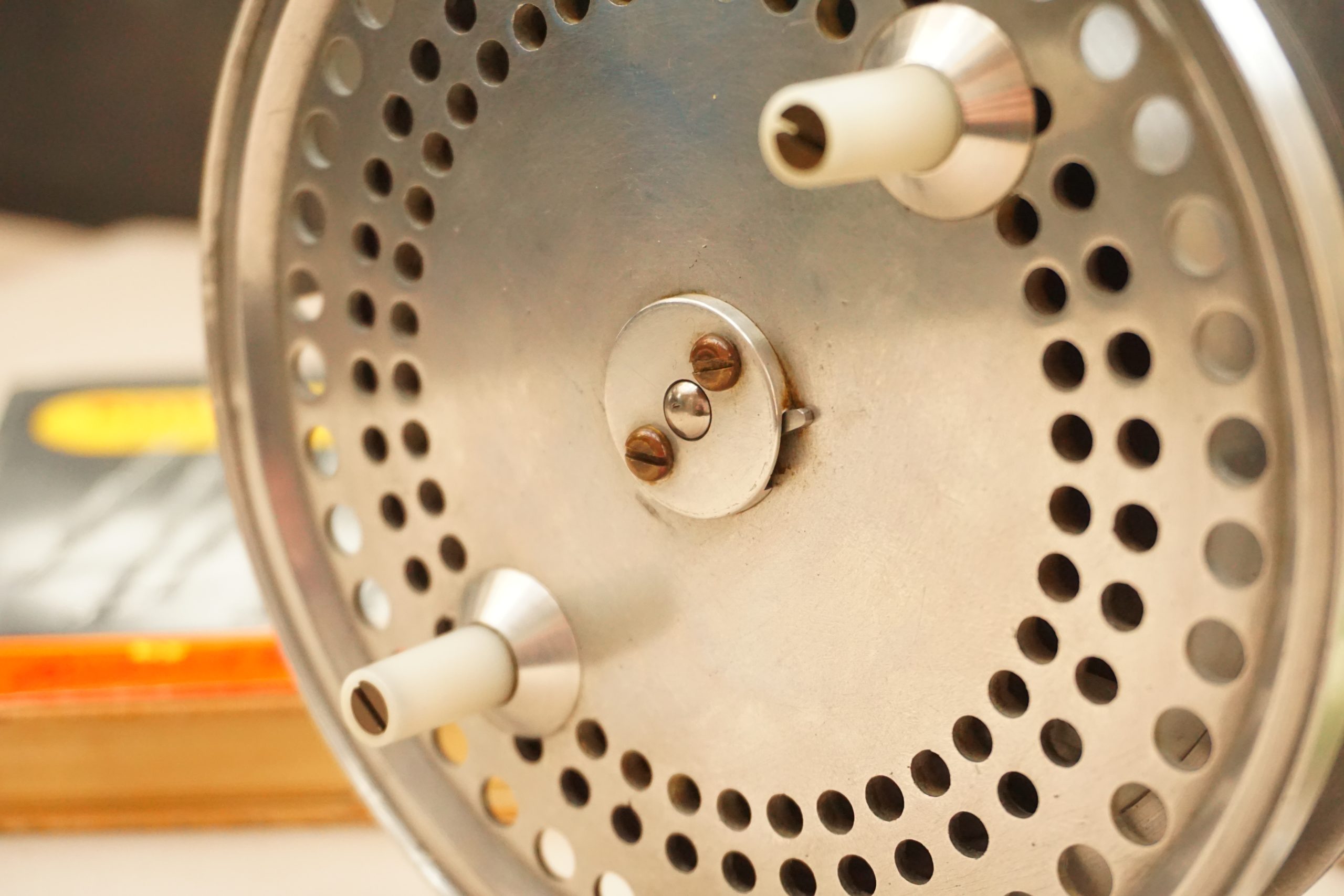
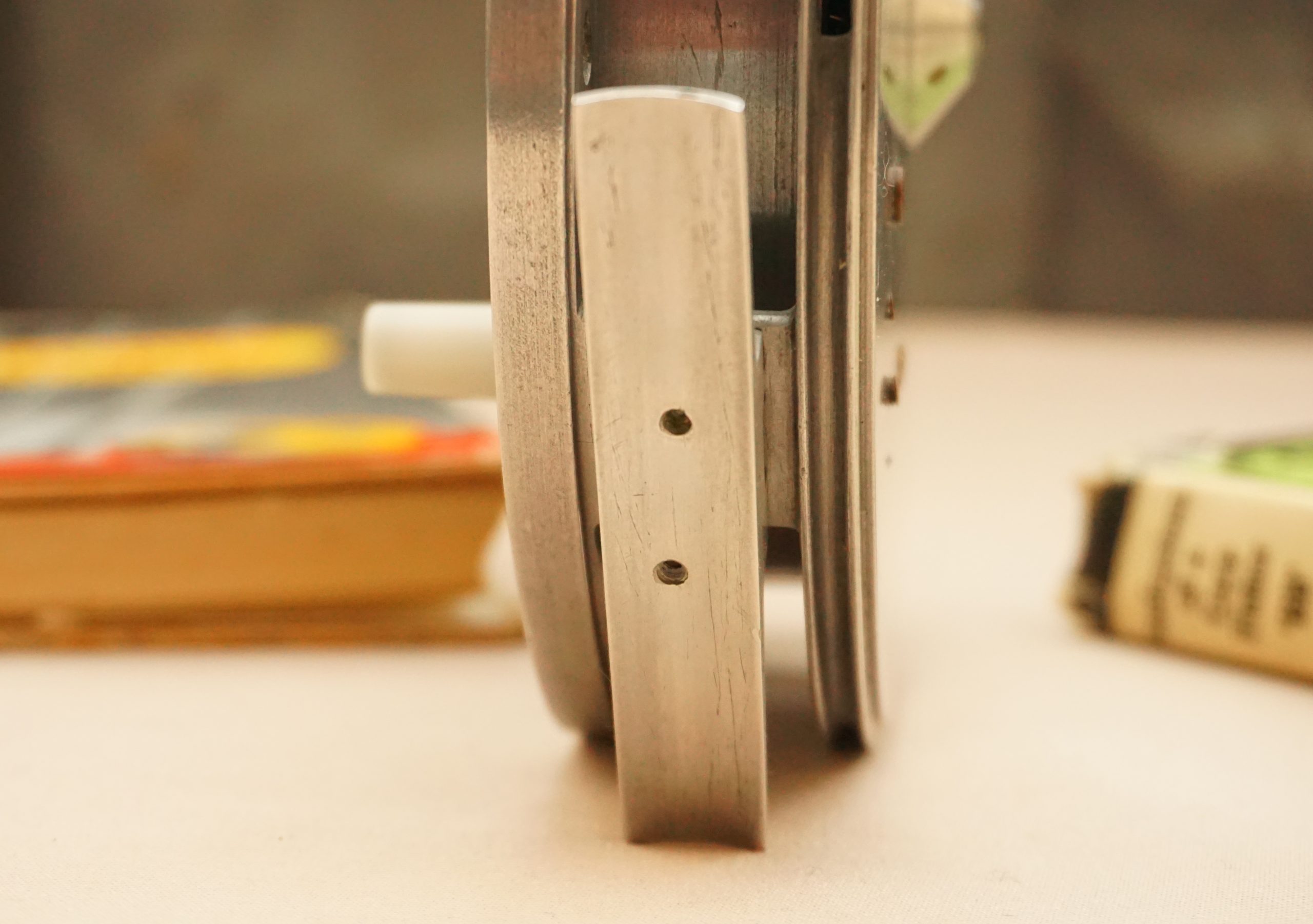
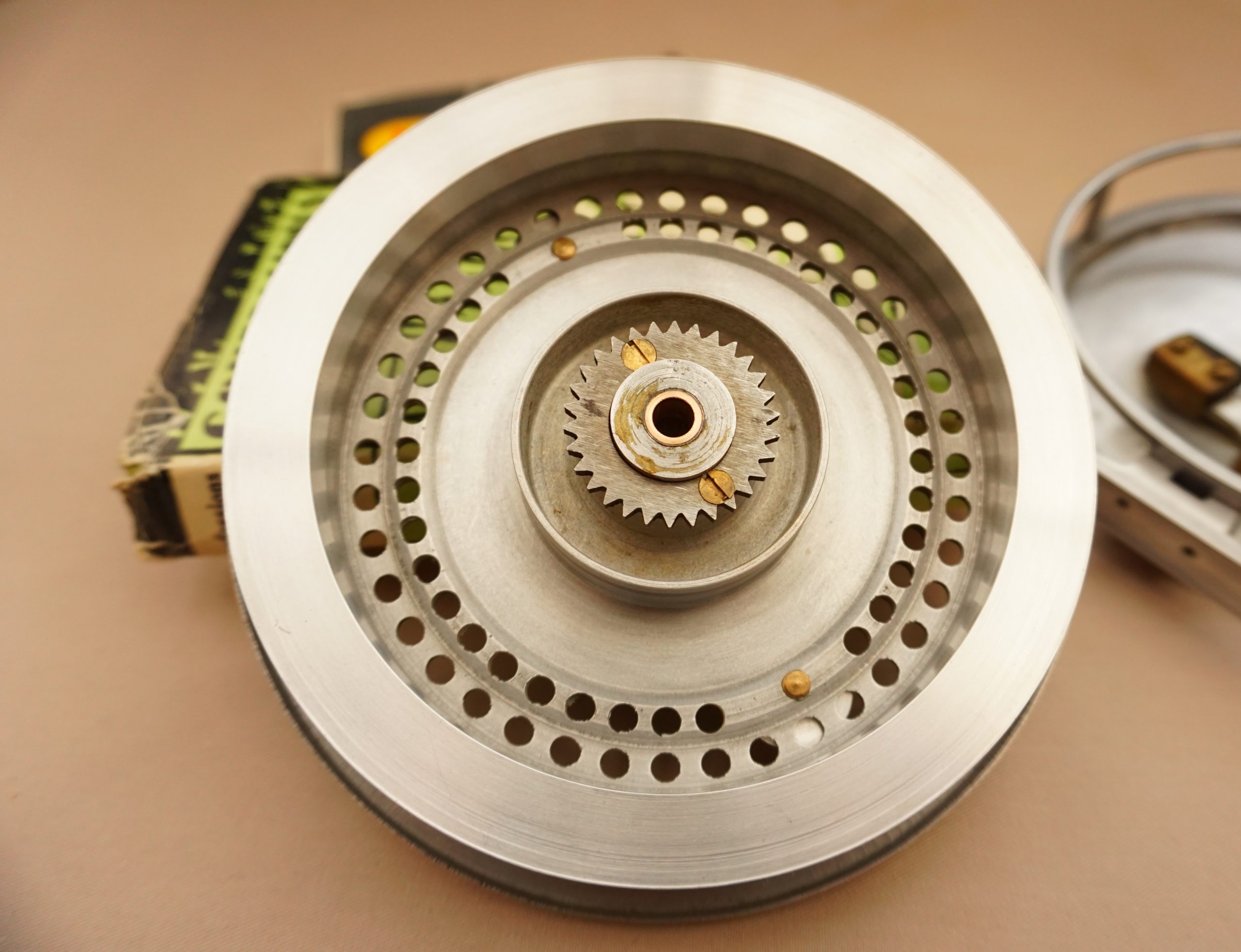
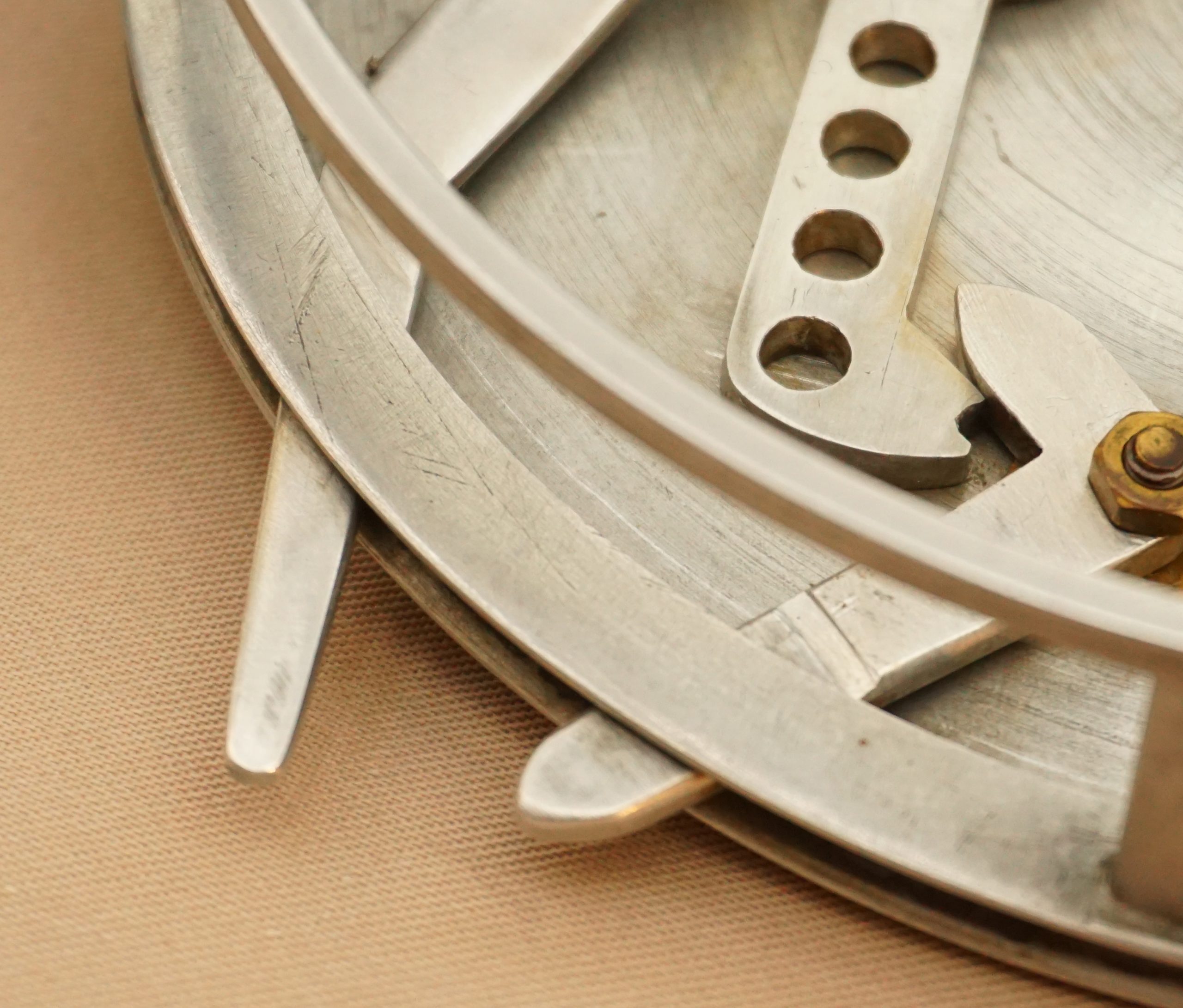
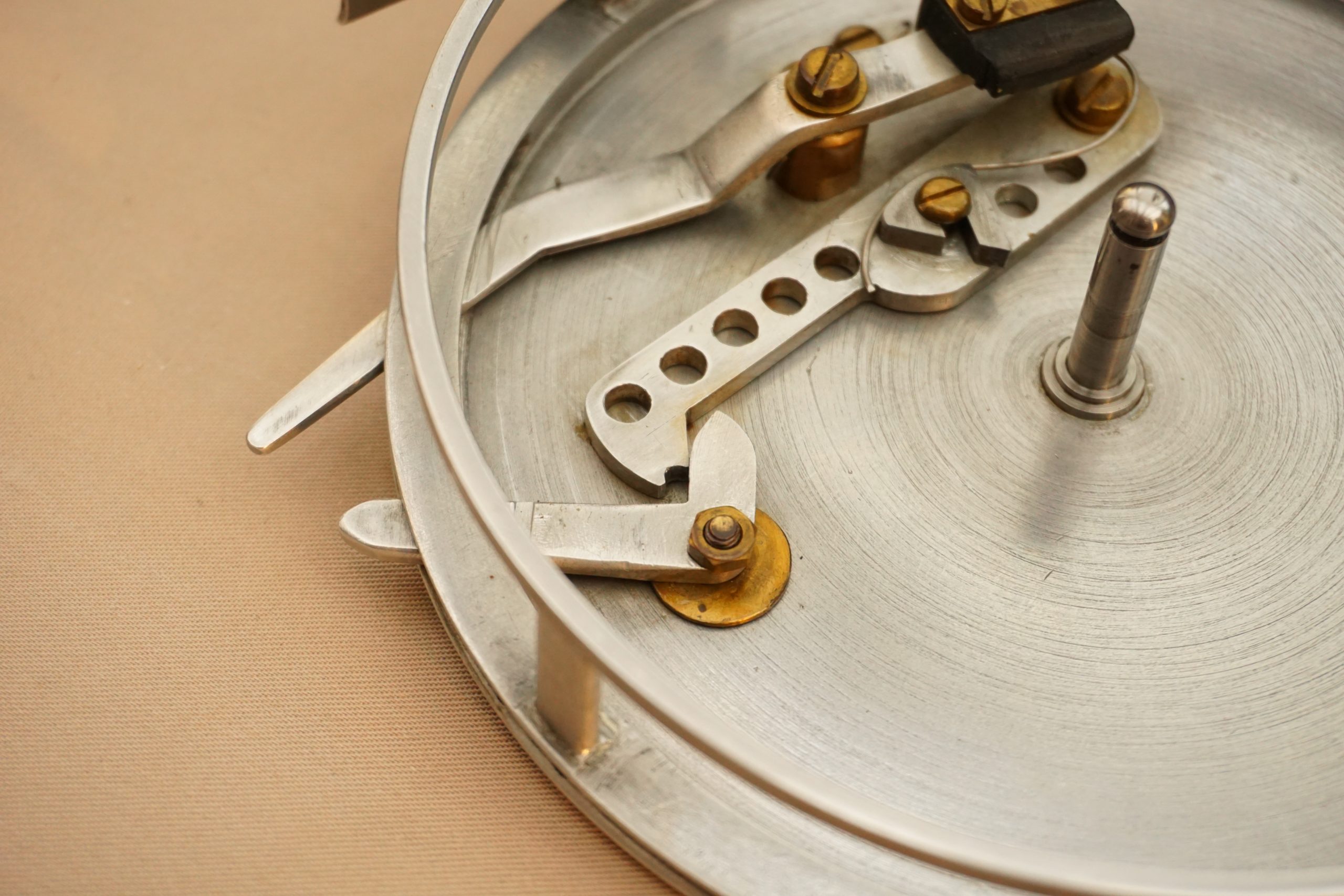
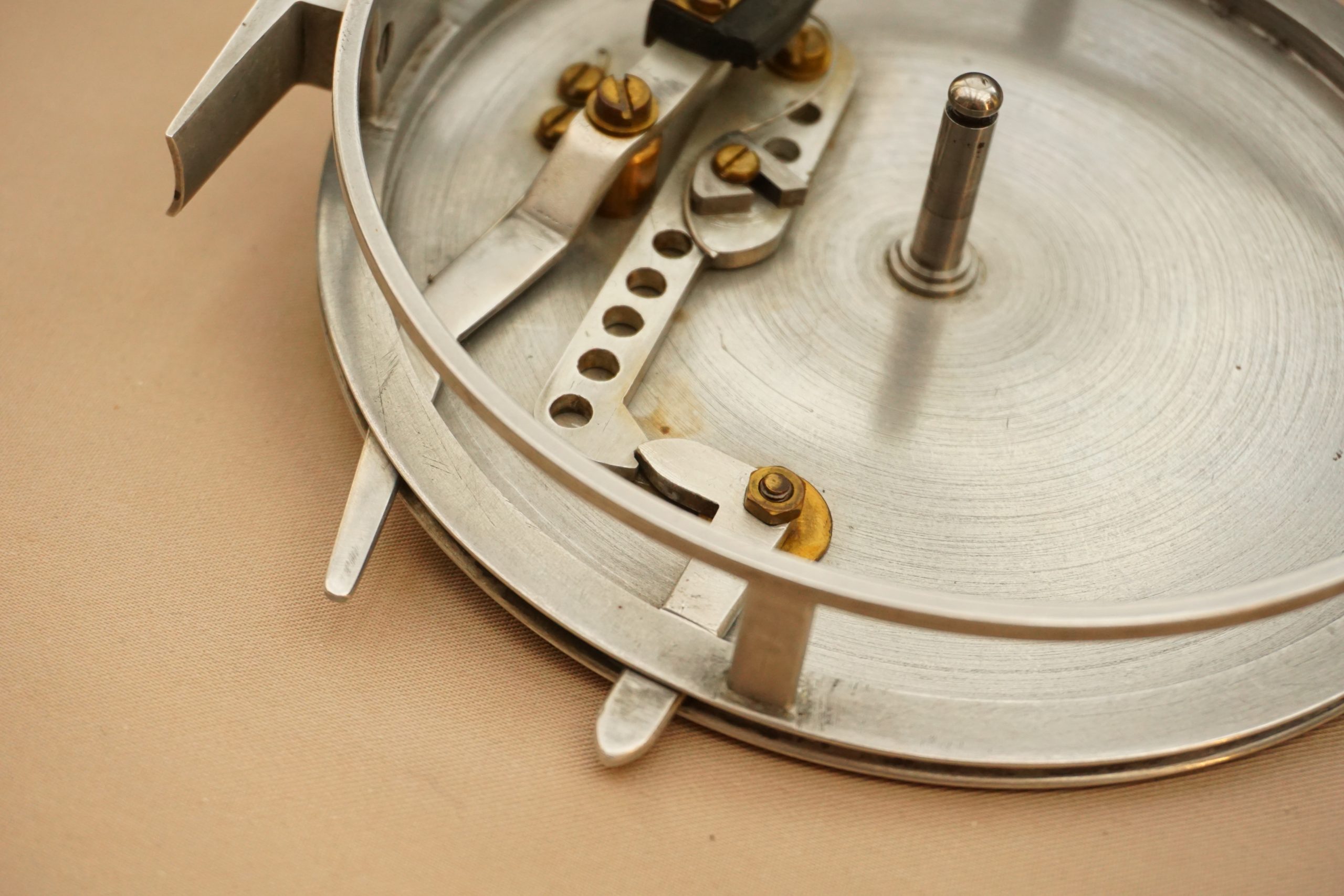
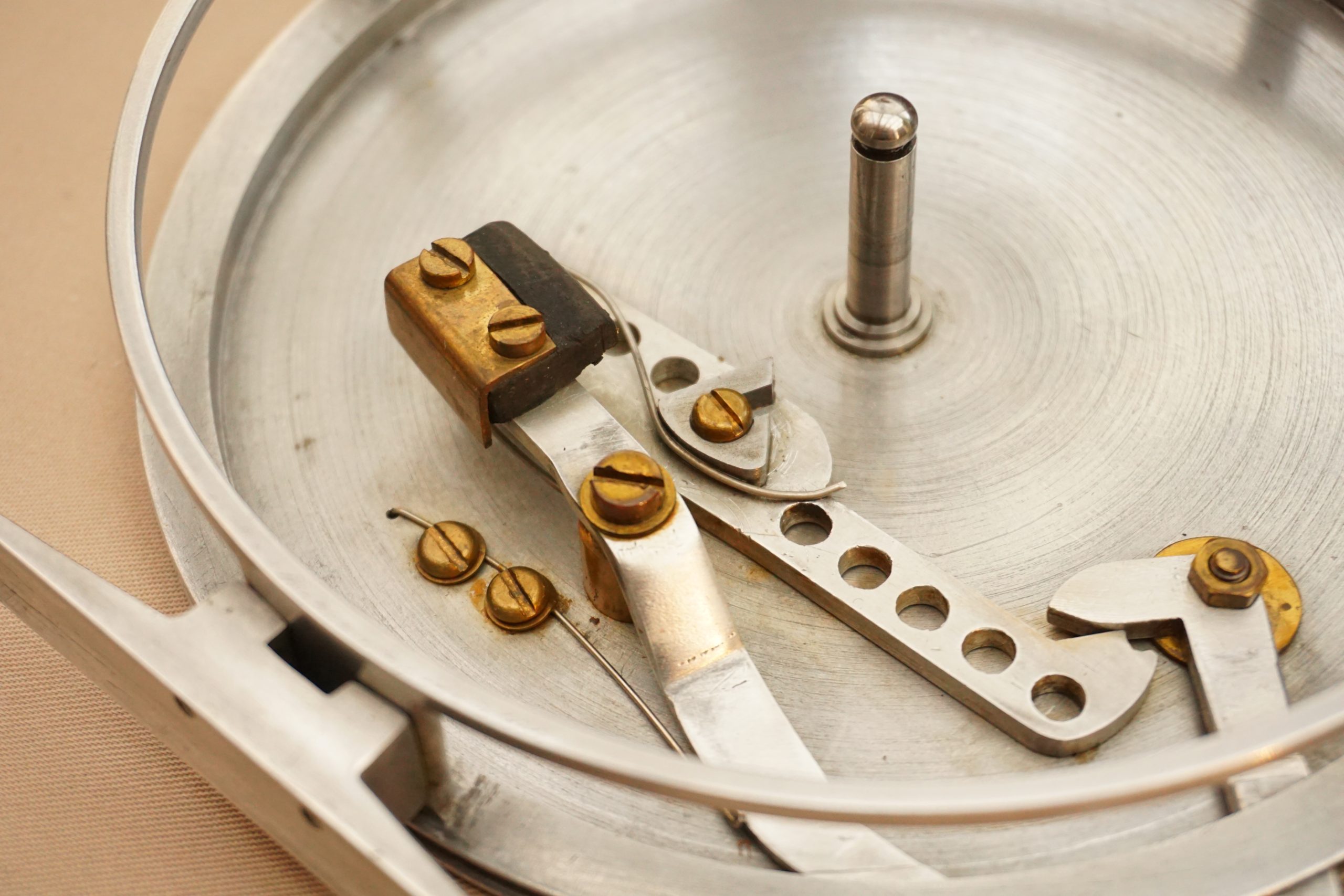
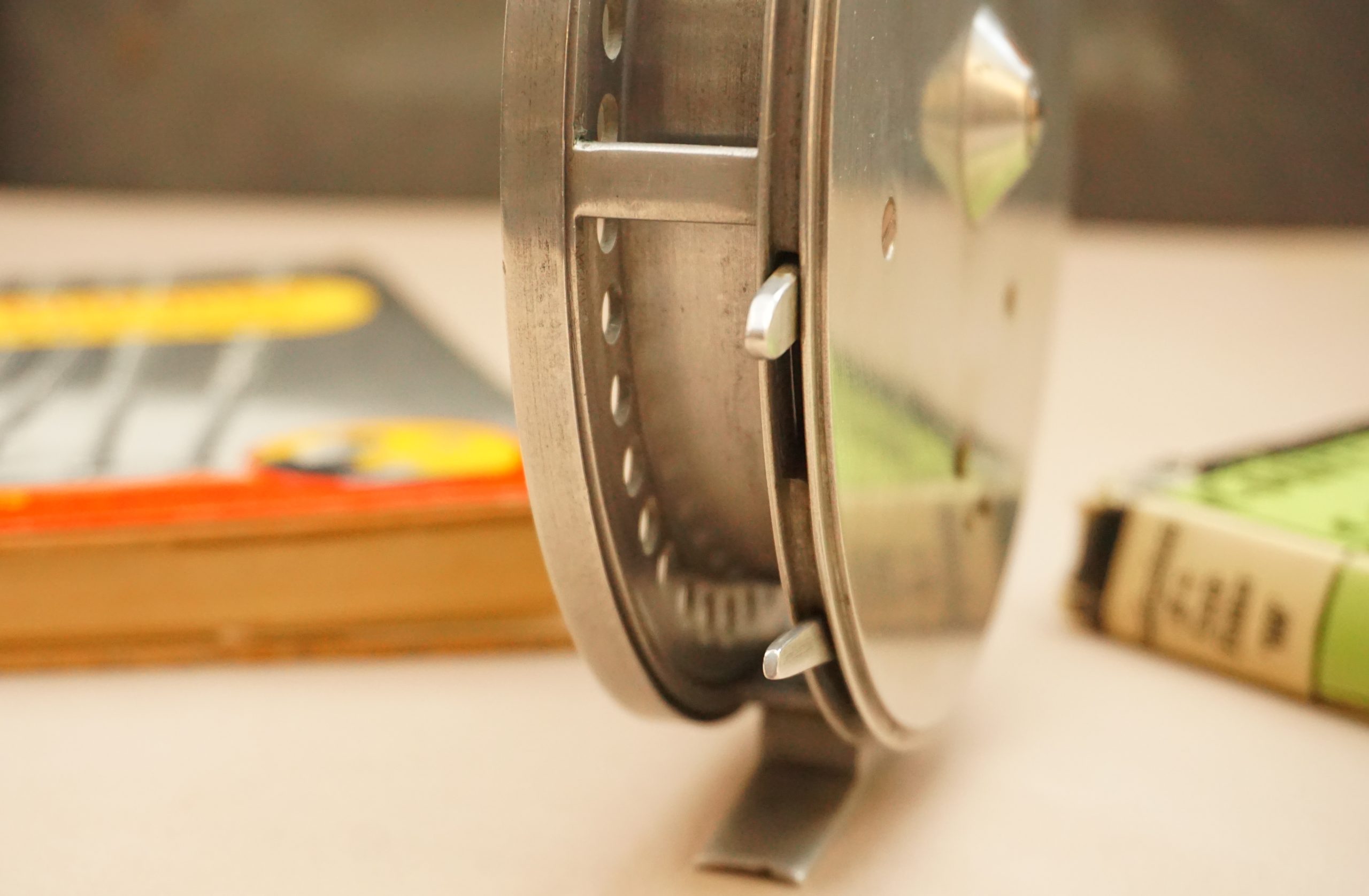
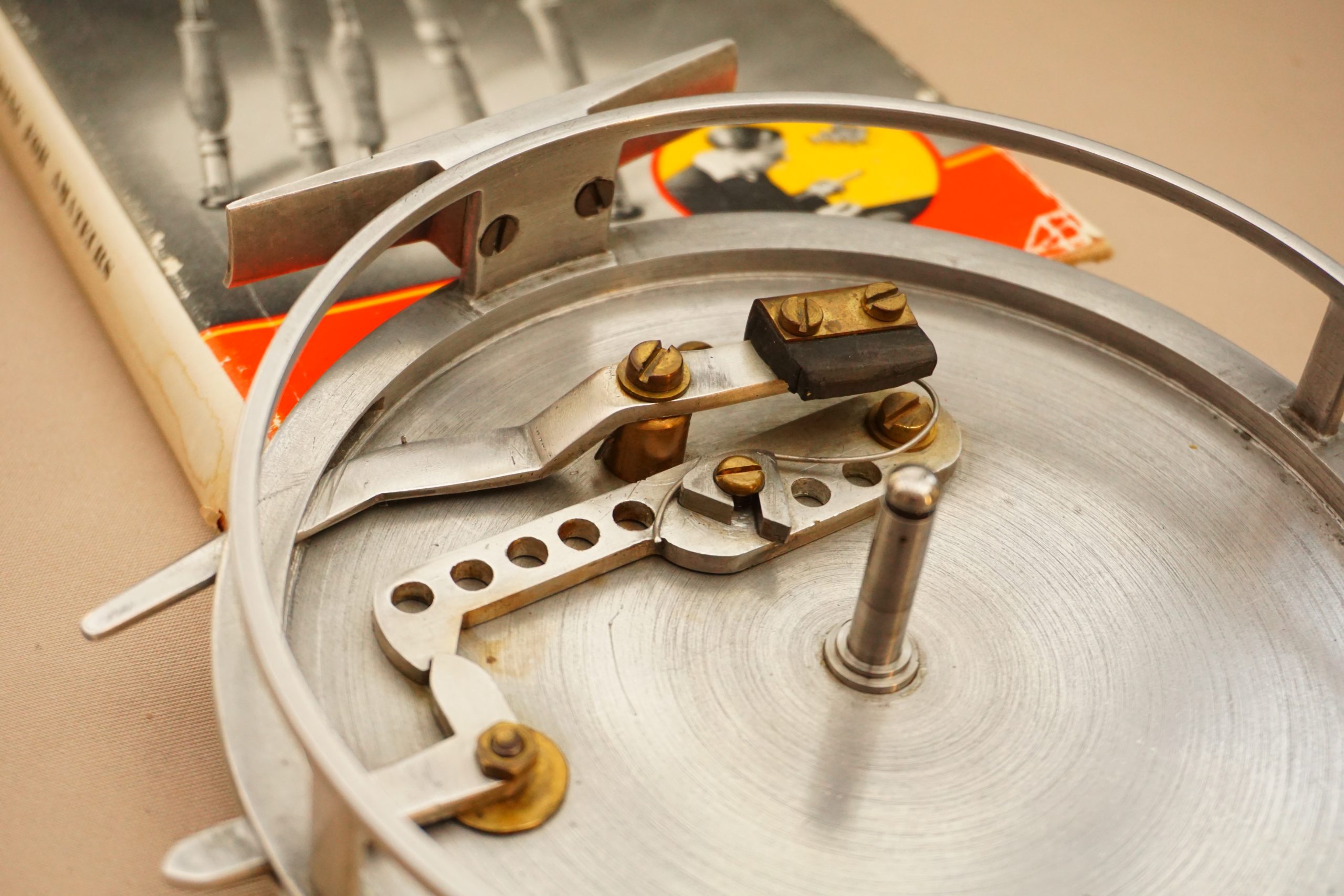
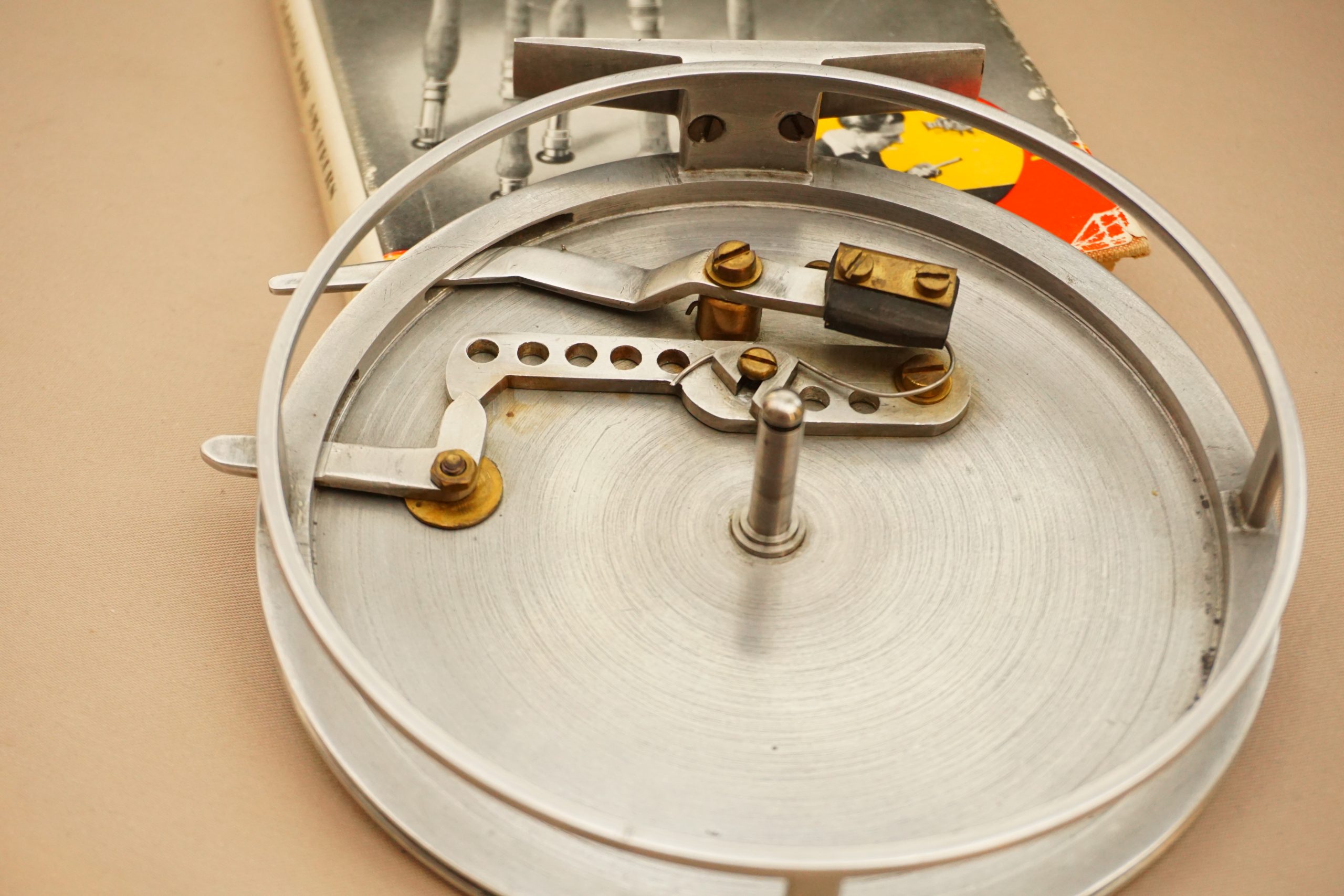
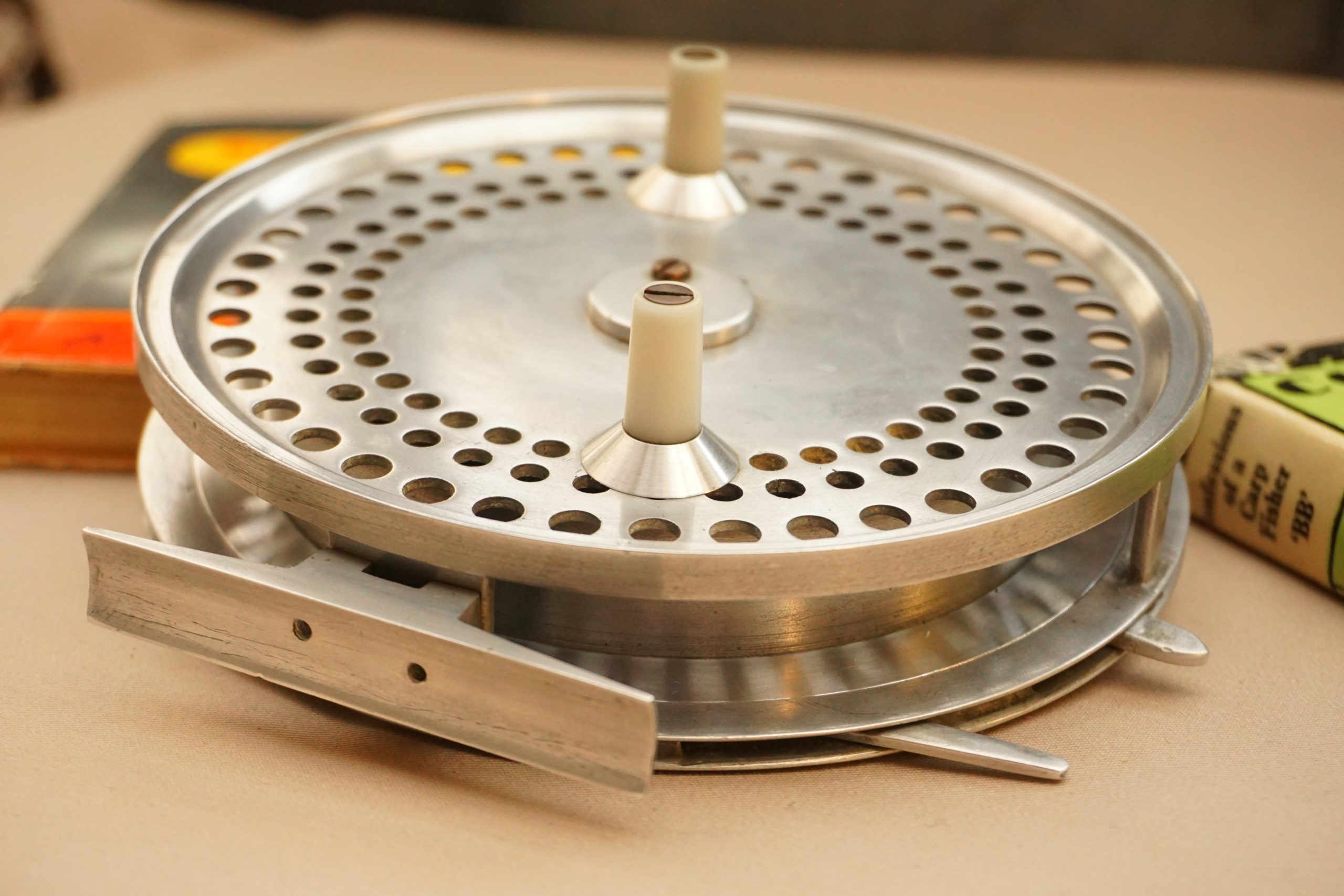
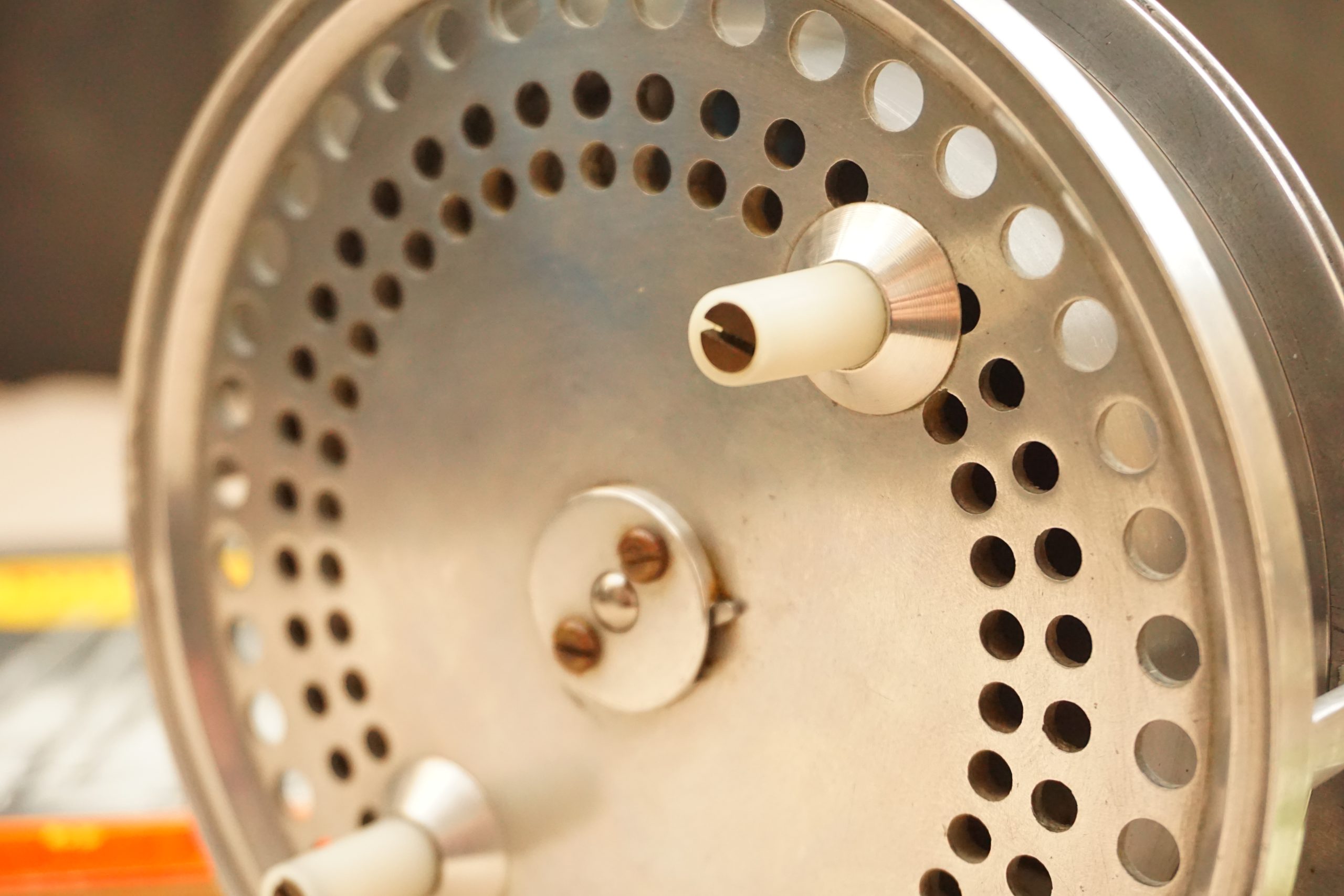
A Richard Walker 5¾” x ¾” centrepin carp reel.
Attributed to Richard Walker c1947-1948. SOLD
£2,500.00
It’s a matter of record that Richard Walker made the ’BB’ reel for his friend Denys Watkins-Pitchford in the late 1940s. An earlier reel he’d previously made for himself, without a brake lever (which he gave to Jack Thorndike), resurfaced a few years ago on eBay. It was bought by John Nightingale, who thought he was buying a Barry Grantham replica of the BB reel. Len Arbury, then the owner of BB’s reel, had the pleasure of telling him that he’d just got very, very lucky.
Both of these reels are now part of Steve Chambers’ stupendous collection. I’ve written about them at length elsewhere and they’re as famous as Walker’s MK IV, Chris Yates’s tea pot and the Redmire ghost.
Those of us who love this sort of tackle thought most of the really important artefacts from the Carp Catchers Club era had been unearthed, so I was surprised when a large centre pin reel very much like BB’s turned up. Some friends of mine were dealing with the collection of the late Chris Seacole. There was something ‘off’ about the Barry Grantham ‘BB’ replica in Chris’s hoard. Simply put, it turned out not to be a Barry Grantham reel.
Frustratingly, nobody seems to know who Chris Seacole bought the reel from. I rather think that Chris, an exceptionally jovial and ebullient man, thought it was one of Barry Grantham’s, or he’d have done some digging into its history
I sent pictures of this reel to Barry Grantham and he confirmed that it was nothing to do with him. During the course of our chat, Barry told me about a man who’d visited his stand at an angling exhibition in the early 1990s. Barry’s visitor told him that BB’s reel wasn’t unique. Walker made two of them, he said. Barry told him that Walker had indeed made two reels, but the first, which became known as the Thorndike reel, was different. It lacked a lever brake, for one thing. No, the gent insisted, Walker made two reels with lever brakes, quite aside from the first (Thorndike) version. Having nothing but received wisdom to rely on, Barry stood his ground. They’d reached an impasse. The argument ended. The man departed and the matter didn’t arise again –until now.
Barry didn’t catch the man’s name. Their encounter took place over thirty years ago. Who was he, I wonder, and what evidence might he have had for his assertion that Walker made two BB-style reels? Perhaps he was remembering this:
Page 16, 1st edition of Drop Me A Line:
“I have another reel, blood-brother to the one Michael Traherne (‘BB’) speaks of in his latest book, Be Quiet and Go a-Angling, which is used when monsters are expected and snags are numerous. It is really an oversized version of Hardy’s ‘Eureka’ bottom reel – 5¾” diameter, ¾” wide in the drum, with finger-operated brake lever (my underlining) in addition to the optional check and exposed flange. This carries a plaited line with a breaking strain of 18lb. and is used for attempts on Mr. Buckley’s record.”
Here, Walker tells us he has a carp reel with a lever bake, just like BB’s. The earlier ‘Thorndike’ reel has no such brake. Our mystery reel has some improvements and developments when compared with BB’s magnesium reel -small touches here and there, but noticeable to the keen observer. Having made a reel for his friend BB, mightn’t he have made one for himself, with some refinements?
The mystery reel is very much an artisanal piece, with a great deal of hand work in evidence –hand work that is very strongly redolent of Walker’s. Indeed, when my colleague Colin and I received this reel, we were struck by its similarities with the BB and Thorndike reels, both of which we’d spent a good deal of time with. One develops a feel for these things when one’s been making fishing tackle for forty years. In a manner of speaking, the reel displayed the hallmarks of Walker’s other work.
Steve Chambers and Pete Rogers came over recently with the BB and Thorndike reels so that we could compare them with the ex-Seacole reel. We agreed that it looked and felt as though it had been made by Richard Walker. Equally, we had to concede, it may, just possibly, have been made by someone else, a long time ago, who’d had access to Walker’s dimensions and/or drawings, or to the reel itself.
We must bear in mind that in the immediate post-War period, there were very few carp anglers in the UK. Communication between them was mostly via the Fishing Gazette and through the post. How likely is it that someone else knew of Walker’s reel making, had sufficient interest in carp angling to want such a reel, knew or had access to Walker’s drawings and/or BB’s reel and had the means to make such a reel for themselves? Exceedingly slim, I’d say.
After looking long and hard at the three reels together, and bearing in mind what Walker tells us in Drop Me A Line, I’m increasingly persuaded that our mystery reel is Walker’s 2nd carp reel.
*Since writing the above, shortly after Classic Angling magazine published a piece I had written about the reel, I have heard from David Petty, well known collector of fine fishing tackle and author of One Man One Rod. David told me that he and Richard Walker enjoyed a warm friendship over many years. When the subject of reels came up in conversation, Richard Walker told David that he had made two reels with finger operated lever brakes (and two without, so a fourth reel may be awaiting discovery). Walker was emphatic on this matter and David has kindly authorised me to bring this information to light here.
A second possibility is that BB could have loaned out his reel for someone to copy. I happen to know that this did once occur, many decades ago. With BB’s cooperation and some input from Richard Walker, three new versions of BB’s reel were made by an engineer. Modifications were made to the original lever brake mechanism and the overall standard of manufacture was professional. These reels are all together still. Their owner kindly sent me pictures. The reel I’m introducing you to here is not one of them!
Before our meeting, Steve Chambers sent me a scan of an article Dick Walker had written in the April 19th, 1963 edition of Angling Times, in which he makes his case for a lightweight, large diameter centre pin reel. In the penultimate paragraph, he writes:
‘Sixteen years ago, I made a couple of centre-pins out of magnesium- no heavier than the average fixed-spool reel and with a diameter of 5¾ inches, they are still in first class working order.
“BB” has one and Jack Thorndike has the other. They aren’t the last word by any means, but surely the tackle trade can do better in 1963 than I did in 1947!’
When I first read this, I thought our hopes for the mystery reel’s provenance were dashed. On re-reading it, I feel far less perturbed. Walker isn’t telling us that he didn’t make any other centre pins, he’s simply pointing out that it’s possible to make a really large centre pin that’s not too heavy, and he’d done so himself, twice, from lightweight magnesium alloy.
For those of us who are closely in touch with our inner nerd, it’s interesting to note that the Thorndike (no lever brake, magnesium back & spool) reel weighs 10.4 oz, the BB reel (lever bake, magnesium back & spool) 13 oz and the mystery reel (lever brake) 14.2 oz. The mystery reel looks to me as though it’s made from regular full fat aluminium, which would explain its one ounce weight gain over BB’s reel. Walker must have found the drama of machining magnesium quite tiresome. After all, the swarf caught fire when he was machining BBs reel!
In conclusion: Having handled and inspected the mystery reel, spoken with David Petty and carefully considered Walker’s paragraph about his reels in Drop Me A Line I feel that the balance of evidence is in favour of this being Walker’s own lever brake carp reel.
I am extremely grateful for the generous and invaluable help given to me during my research into this reel by Colin Whitehouse, Steve Chambers, Pete Rogers, Barry Grantham and David Petty. Thank you to Keith Elliott for publishing my article about the reel in Classic Angling.
The reel is available to buy and anyone interested in it is welcome to make an appointment to view it.